Arthroscopy Across Joints: Hip, Ankle, Wrist, and Elbow
17 June 2026 · By Arthroscopy Mauritius
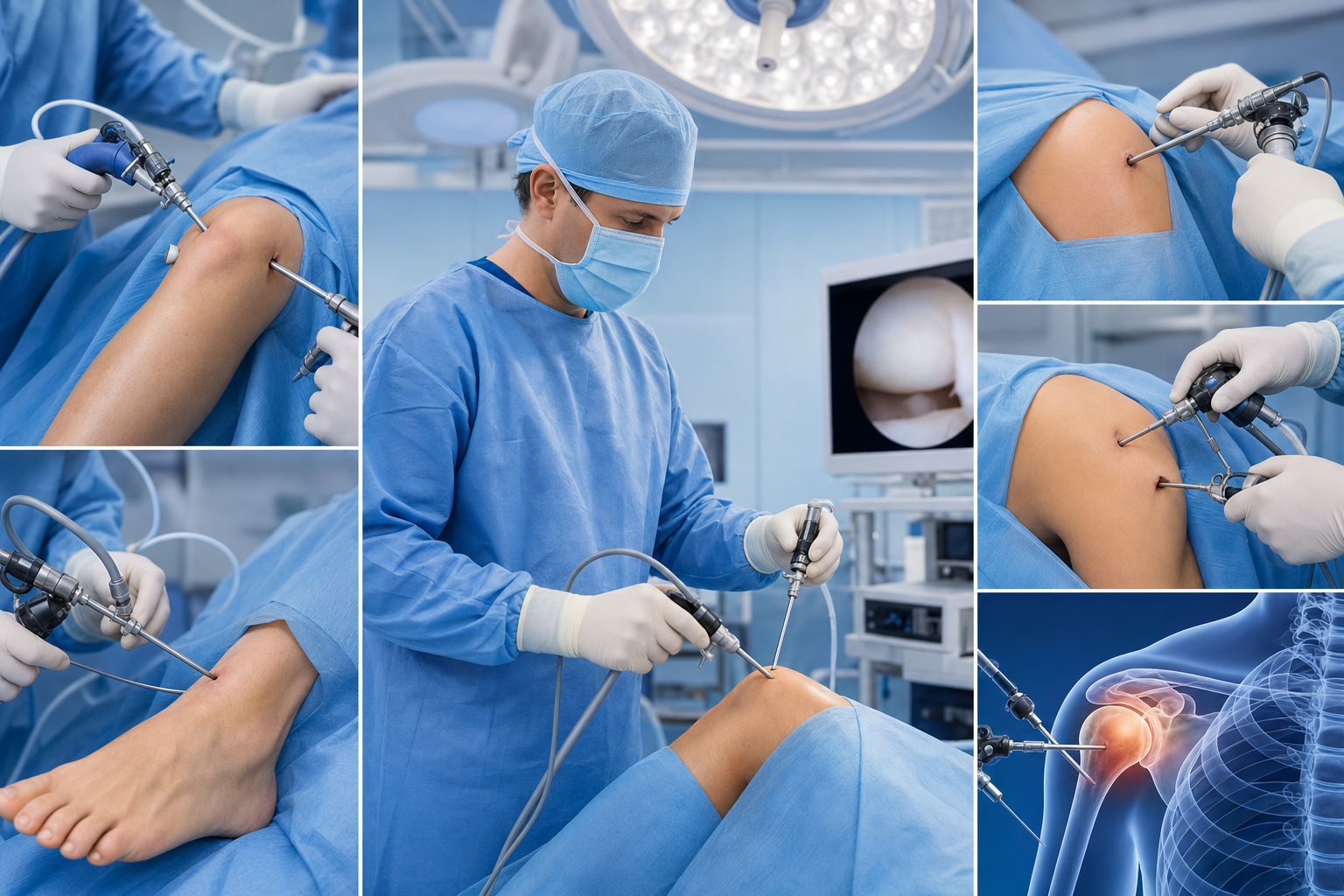
For many clinicians and patients, arthroscopy still means the knee or the shoulder. Those two joints account for most procedures, but the technique now reaches almost every synovial joint in the body. Smaller scopes, refined portals, and a generation of surgeons trained specifically in joint preservation have expanded arthroscopy into the hip, ankle, wrist, and elbow. Each of these joints brings its own anatomy, its own indications, and its own technical demands.
Hip arthroscopy
The hip has seen the most dramatic growth. Once considered too deep and too constrained to scope safely, it is now a preferred surgical approach for many cases of femoroacetabular impingement (FAI). In FAI, abnormal contact between the femoral head-neck junction and the acetabular rim, described as cam and pincer morphology, damages the labrum and cartilage and produces pain and stiffness in active adults.
Reasonable candidates typically have symptoms lasting several months, a positive impingement sign on examination, and imaging that confirms the bony morphology, such as an increased alpha angle. Through two or three portals, the surgeon can reshape the bone, repair or reconstruct the labrum, and address chondral damage. Registry data, including large national datasets, show meaningful improvement in patient-reported outcomes after arthroscopic FAI surgery. The technique carries a real learning curve, requires careful traction and capsular management, and depends heavily on selecting patients who have impingement rather than established osteoarthritis.
Ankle arthroscopy
The ankle is well suited to arthroscopy for a defined set of problems. Anterior impingement, often from bony spurs or soft-tissue thickening in athletes and after injury, responds well to arthroscopic debridement. Osteochondral lesions of the talus can be assessed and treated, loose bodies removed, synovitis addressed, and post-traumatic scar tissue released. Posterior ankle problems, including posterior impingement, can be reached through a posterior approach with the patient prone. As with every joint, the value of the scope lies in matching it to a mechanical problem it can genuinely correct rather than using it for diffuse degenerative pain.
Wrist arthroscopy
The wrist is a small joint with complex ligamentous anatomy, and arthroscopy has become central to both diagnosis and treatment. The classic indication is the triangular fibrocartilage complex (TFCC), the structure on the ulnar side of the wrist whose tears cause pain and instability; arthroscopy allows both accurate diagnosis and repair or debridement. Other indications include removal of loose bodies, treatment of ganglia, assessment and management of carpal instability, and assistance in reducing intra-articular fractures of the distal radius and scaphoid. Small-joint scopes and, increasingly, wide-awake local anesthesia have made many of these procedures less invasive for the patient.
Elbow arthroscopy
The elbow rewards arthroscopy for several well-defined conditions, including loose body removal, treatment of osteochondritis dissecans of the capitellum, release of contractures and arthrofibrosis to restore range of motion, management of early arthritic osteophytes, and selected cases of lateral epicondylitis. It also demands respect. The neurovascular structures around the elbow lie close to the working portals, so safe practice depends on precise portal placement, sound knowledge of the anatomy, and appropriate experience. In the right hands, elbow arthroscopy can restore motion and relieve mechanical symptoms with far less morbidity than open surgery.
Common threads
Across all four joints, several principles recur. First, arthroscopy expands what can be done through small incisions, but it does not change the fundamental rule that the procedure must address a mechanical problem the scope can fix. Second, smaller and more specialised joints carry a steeper learning curve and, in places such as the elbow and hip, a higher premium on anatomical precision. Third, the trend toward joint preservation, repairing and reshaping rather than removing, runs through every one of these areas.
What this means in practice
For clinicians outside the sub-specialty, the practical message is one of awareness. Persistent mechanical symptoms in the hip, ankle, wrist, or elbow, particularly in active patients and after trauma, may be amenable to an arthroscopic solution that did not exist a generation ago. Timely referral to a surgeon experienced in that specific joint, rather than a generalist, gives the patient the best chance of an accurate diagnosis and an appropriate procedure. For patients, the reassuring reality is that keyhole techniques, and the shorter recoveries that often come with them, now extend well beyond the knee and shoulder. As training and instrumentation continue to improve, the list of joints and conditions that arthroscopy can help is likely to keep growing, always within the discipline of careful patient selection.
Sharing this with a patient? The plain-language guides live in the patient lane.
Cross over →Part of Mauritius' growing medical-technology network. Explore the wider Medtech medical-technology network.